Social Media & Surgery Attracting Patients & Recognizing Apical Scars

Have you ever been given a compliment by which you were kind of baffled, but now this compliment has greatly influenced your behavior and/or how you see yourself? Ruddle & Lisette discuss this idea in the Opener. Afterward, the pair enlighten viewers on how you can utilize social media to attract patients. Then, Ruddle is at the Board turning his attention to surgical matters and how to differentiate between an apical scar and a LEO. Finally, the show closes with a little self-promotion; Ruddle & Lisette share why theruddleshow.com is a recommended resource you really want to include in your life.

Show Content & Timecodes


00:37 - INTRO: Influencers – Baffling Compliment
08:20 - SEGMENT 1: Using Social Media to Attract Patients
28:06 - SEGMENT 2: Surgery – Apical Scars vs LEOs
55:10 - CLOSE: Recommended Resource – theruddleshow.com

Extra content referenced within show:


‘Ruddle Show’ episodes & podcasts referenced within this episode:


Select PDF content displayed below. See Ruddle's complete library of downloadable PDF content at www.endoruddle.com/pdfs

See also Ruddle's complete Just-In-Time® Video Library at www.endoruddle.com/jit

Downloadable PDFs & Related Materials

The Ruddle Show Graphic
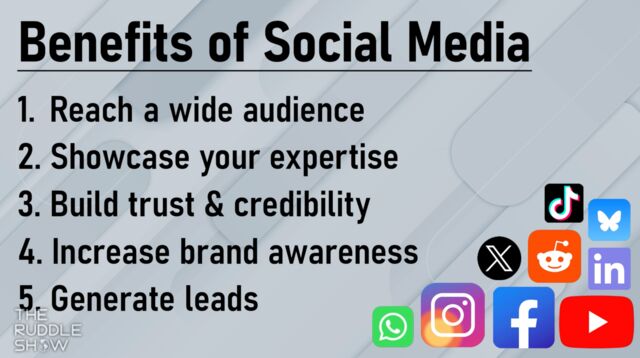
"Benefits of Social Media"
Jul 2025

Here are some of the benefits as to why dentists should incorporate Social Media into their dental practices...

Ruddle Article
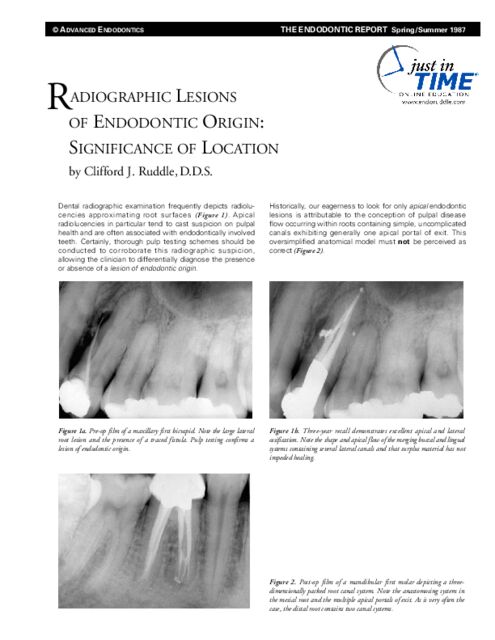
"Radiographic LEOs: Significance of Location"
Apr 1987

Dental radiographic examination frequently depicts radiolucencies approximating root surfaces. Apical radiolucencies in particular tend to cast suspicion on pulpal health and are often associated with endodontically involved teeth...

Ruddle Article
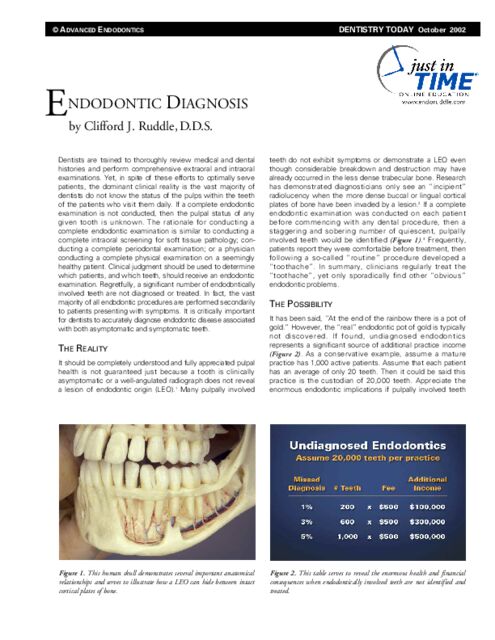
"Endodontic Diagnosis"
Oct 2002

Dentists are trained to thoroughly review medical and dental histories and perform comprehensive extraoral and intraoral examinations. Yet, in spite of these efforts to optimally serve patients, the dominant clinical reality is...

The Ruddle Show
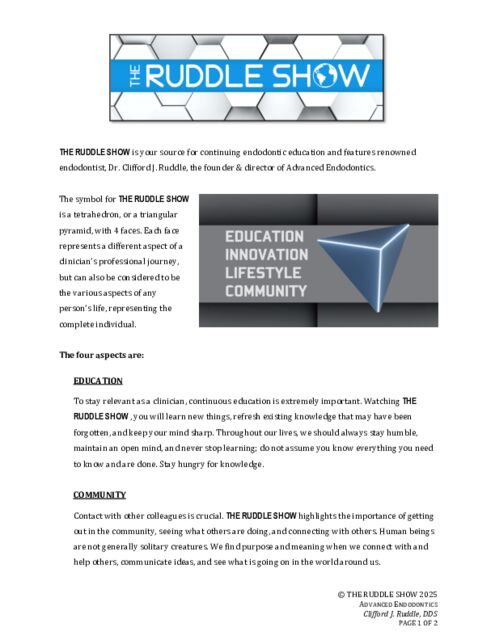
"Ruddle Show Tetrahedron"
Jan 2025

The symbol for THE RUDDLE SHOW is a tetrahedron, or a triangular pyramid, with 4 faces. Each face represents a different aspect of a clinician’s professional journey, but can also be considered...

Related Polls

Podcasts You May Also Like

1:39:58

Ruddle on the Radar

Key Topics on Ruddle’s Mind – June 2025

1:30:40

Ruddle on the Radar

Key Topics on Ruddle’s Mind – April 2025

1:30:15

Endo-Antral Connection Expanded

Podcast Inspired by Dr. Tataryn's Ruddle Show Presentation

You May Also Like

54:01

s08 e08

Artificial Intelligence & Common Errors

Incorporating AI & Endo/Restorative Errors

56:14

s10 e03

Advanced Endodontic Diagnosis

Endodontic Radiolucency or Serious Pathology?

1:03:11

s12 e03

The Endo-Antral Connection

Special Guest Presentation by Dr. Roderick Tataryn

Disclaimer

This transcript is made available by The Ruddle Show in an effort to share opinions and information, and as an added service. Since all show text has been transcribed by a third party, grammatical errors and/or misspellings may occur. As such, we encourage you to listen/watch the show whenever possible and use the transcript for your own general, personal information. Any reproduction of show content (visual, audio or written) is strictly forbidden.

OPENER

Lisette

…So #3 on the list is build trust and credibility, and this one was a little of an oddity at first because I don’t really associate social media with trust and credibility…

INTRO: Influencers – Baffling Compliment

Lisette

Welcome to The Ruddle Show. I’m Lisette and this is my dad, Cliff Ruddle.

Cliff

How you doing today?

Lisette

Pretty good, how about you?

Cliff

Excellent. And how’s our audience doing? I hope you’re doing great; thanks for joining us.

Lisette

Okay, well today we’re going to open the show with an Influencers segment. This is where we identify something or someone who has greatly influenced our lives and how we think. It could really be anything. It could be a trip, a movie, a book, a teacher; the possibilities are really endless. In the past on The Ruddle Show we’ve talked about a childhood friend, we’ve talked about a technology, and also a sports announcer. Today we are going to reveal a baffling or surprising compliment we received, and it so happens that each of these compliments we’re going to talk about is when we were kids. And what these people said to us really influence how we think going forward and how we live our lives.

So why don’t you start first. I think you’re going to talk about something a baseball coach said to you.

Cliff

Yeah. First I’ll set it up; it’ll take about an hour.

Lisette

Okay.

Cliff

When I was – I think it was 1961 and I was about (I’m making this up) about 13 – my family moved from Seattle to Boseman, Montana. And of course they know I loved baseball, so they got me in Little League. There were several divisions of Little League, but I was placed in the 13 and 14- year-olds.

So I played my first year at 13, and when I sent back to go the next year, my coach came up to me and said you know, because of you’re hitting and you’re such a good little ballplayer, we’d like to have you play up and I’ve talked to a guy named Frank Sitzes (phonetic) in Babe Ruth League. That was the next league up, that was 16-year-olds. He said he’ll take you on the team; do you want to go there? It was good news/bad news. I was excited to go, but I was a little worried that at my age, at 14, would I be able to compete?

So anyway, I went over and I went through their little Spring Training session and I made center field. And the season started and wouldn’t you know, I got into a batting slump. It wasn’t just like 0 for 7 or 0 for 9; it might have been like something – I don’t even know if I want to say it on camera – it might have been like 0 for 20. Anyway, I didn’t think I was ever going to hit again.

One day after the game, I probably had my head down, and I remember Frank (Coach Sitzes) came over and he said: Ruddle! He said come on, you’re a hitter. We know you’re a hitter that’s why we brought you up here because you’re a hitter. You’re not going to go hitless forever, so start thinking you’re going to hit! See the ball, hit the ball Ruddle!

So he gave me some confidence and so I decided to try really hard. And that’s probably what was the problem, because he said to me later: you’re pressing, you’re pressing. Just relax at the plate. See the ball, hit the ball.

So I started hitting; I came out of the slump. But it took some determination, I had to keep at it. But another thing he helped me learn besides telling me I was a hitter, a natural hitter, is he said there’s lots of things you can do when you’re in a slump and still be valuable to our team. I didn’t know what he meant exactly right then, but as I look back yeah, I could play a better center field, I could hustle faster, I could throw to the right base, I could throw guys out, I could do all these things. But in the dugout, you can be more excited. You can complement people that are hitting and just swallow your pride because you know you will be hitting again.

So anyway, that was the little story that really helped influence my life. I think later in life as a teacher, I’d use some of those same things I learned from Frank Sitzes when I was 14 in Babe Ruth League to realize a lot of the people that came and took courses from me and did course work over the decades, they were really good dentists and maybe they just needed to work on their endodontics. So I learned to listen to them, give them authentic and unexpected praise if I could, at least find something to compliment them on, give them encouragement. And then of course they’d leave the class, send back cases, start sending me emails of their work, and I started to see them grow.

So I think that really helps in life to say a nice compliment to somebody that’s unexpected. It probably should be a surprise and it should be authentic.

Lisette

Yeah. When we were talking about this before we did this segment, and we were talking about this compliment, and I noticed that you were – that there was a lot of power that comes from someone believing in you. That that would really give you a lot of confidence. Then there’s the importance of persistence; you just kept trying, you didn’t give up. And then also the idea that you can find a way to participate. In a team if something’s not working for you, find another way to contribute.

And you’ve also kind of taken that into your teaching. Encouragement; the power of encouragement is really huge.

Cliff

So maybe try to give a few compliments out to young kids, impressionable people, fellow colleagues, doctors, associates, partners.

Lisette

Right. It might not really seem like a lot to you, but it’s very powerful for the person. We’ve talked about random acts of kindness too, and how powerful they are for the receiver of that.

Cliff

What about you?

Lisette

Okay, well for my story, we went to this summer day camp for many years when we were kids, and it kind of had a Native American theme. We did all kinds of super fun activities, I loved it. We did archery, riflery, swimming, dance, trampoline; we did so many different things. I loved the activities. However, I was not in the same – we were like Indian tribes because it had a Native American theme – I was not in a tribe with my sister or my cousins who sometimes came with us. I was all by myself and I felt just really super shy; really felt like I had no friends. And honestly it was a day camp and I was homesick at the day camp. I felt like I couldn’t wait to be home, even though I loved the activities.

So fast forward now a couple of years. I’m looking at some papers my mom had saved of me and Lori, different memento things, and I see my camp progress report for one year at camp. And it said “a real leader, everyone loves being around her, very outgoing.” And I was like oh my goodness; they must have mistaken me for someone else. That was my first thought, because this was not how I felt going to camp.

So what I got out of this is not what you might think. It’s not that I thought oh wow, I actually am a very good leader. No, I was not thinking that. I was thinking of the huge discrepancy between how I felt on the inside and what I must have been showing to people on the outside. And so I’ve just always been very conscious of that as I’ve gone through life. I’ve tried to give that lesson to my kids too; be kind to people because you never know what they’re going through on the inside.

Cliff

I guess with that camp analogy; don’t ever make a decision until you’ve walked in somebody’s moccasins.

Lisette

Right. Like that expression: don’t judge somebody until you’ve walked a mile in their shoes.

Cliff

Moccasins.

Lisette

Or don’t judge a book by its cover. I actually find those types of little quotes to be very meaningful. So anyway, don’t underestimate the power of what you say to someone, because you might actually change their life and how they think going forward. So be careful what you say.

Cliff

Yeah. So to close out for me, give it from your heart, make it genuine, make it unexpected, and you might influence somebody across the decades of their life.

Lisette

Okay, we have a great show today. It has a little bit of endodontics, a little bit of social media, so it’s going to be fun and exciting. Let’s get to it.

SEGMENT 1: Using Social Media to Attract Patients

Lisette

Okay, so it’s no mystery that social media basically dominates our society. It’s how we connect with others, how we entertain ourselves, follow current events, and even look for inspiration. And businesses also use it for marketing and advertising, to hire and also to show expertise, showcase their expertise, to just give a few examples. And you can even use it to attract new patients to your practice.

So this is a segment we’ve actually been meaning to do for a while now, since we found this 2022 Dentistry Today news article called The Five Benefits of Utilizing Social Media to Attract Patients, by Dr. Kevin Varley. However, other segments have taken priority over the years, and that probably says something about us, that we’re not very active on social media. So why is this the case for you, before we get to the article?

Cliff

Well the teacher teaches best what he most needs to be doing. So I’m thinking this is a blueprint for me to get our brand out there a little bit more intentionally. But right now we’re talking about you and more patients.

So I don’t use social media that much, as she’s admitting. I like to go on the AAE Discussion Forum and I like to get the pulse of the small group of people that are there. It’s not just hundreds, it’s just maybe less than 10 every day. And you can kind of tell what they’re talking about, things that they’re interested in. Lots of people are asking for help and questions, so I like to get the pulse of the endo.

And then I use it for communication, you know, texting, emailing, those kinds of things. I like to use it to watch news and sports, I like to use it for – I take a few photos. I don’t take a lot of photos, but when I travel of course I like to take some of my friends. It’s kind of interesting how we looked 30 years ago and 20 years ago and today. And then I do quite a bit of preparation for this kind of format right here, the show or even a podcast. I Google a lot and I kind of keep up to speed, and I actually have been a very good Googler.

So anyway, that’s kind of how I use it.

Lisette

You use your phone, but not social media.

Cliff

Not social media. But the screen time, we have to be aware of that. The average US adult spends five+ hours a day – iPad, iPhone, laptop, screen time, computer, desktops, all the different ways, TV, all that stuff. So we have to be careful because it can be pretty addictive, and all of a sudden you can find yourself just mindlessly looking for what you want to look for, and all of a sudden there’s interruptions and popups and you’re off into the field. You’re in the weeds.

Lisette

Okay. Well I don’t go on social media that much either. I used to be more active on it, but I got kind of disillusioned by it over the years for various reasons I’m not going to go into. But I do have members of my own household constantly sticking their phones in my face showing me hilarious Tic-Tok videos. So I do have some knowledge of hilarious Tic-Tok videos.

Well let’s get back now to the article, and The Five Benefits of Utilizing Social Media to Attract Patients. And we have the list, so let’s bring up a list.

Well the first thing on the list is you can reach a wide audience. That seems pretty obvious.

Cliff

Yeah, and what was staggering to me – I don’t know, the producer will probably have to correct me. I think there are 7 or 8 billion people on the earth, but (5 billion) for sure are documented to be on social media. So chances are there’s a couple patients in there that you might be able to identify with and slide over to your establishment. So (5 billion) is the number.

But be strategic when you get out there on the net. Remember, you’re one of thousands of dentists, so there’s an old expression: birds of a feather like to flock together; or people like people like themselves. So have a message and be intent with it – intentional I should say. Probably the best ones are Facebook and Instagram.

Lisette

For dentists.

Cliff

For dentistos. I was talking to my grandson this morning, and he’s got a presence with his start-up business – 3-D printing and different things – and he told me that that’s not necessarily the best for him. So there’s all kinds of platforms that you can get on, but according to our work, it was Facebook and Instagram.

So you’ve got (5 billion) people; obviously they’re all over the world and you practice here in the now. So be professional. You can put content on there, visual content, befores and afters. You can make observations about something. Or you can be talking about the community you live in. And maybe you have special events you’re going to do in your office. Like it’s going to be giveaway day or something. But anyway, we’ll get into this more as we develop it.

Lisette

Okay. Well the second thing on the list is you can showcase your expertise. Now when I first read this, I kind of thought that it meant that you show your work. But then I was thinking if you’re an endodontist and you’re showing a pre-op radiograph and then a post-op that shows great healing, that might not be so powerful for the average Facebook user. They might not understand how to read a radiograph. But if you’re a cosmetic dentist and you’re showing a before and after, that could be pretty powerful.

How else can you showcase your expertise?

Cliff

Well there’s quite a few ways, but it could start with just – you’ve got to do this faithfully, it has to be done consistently. You can’t just throw something out there and hope it sticks. Remember, these people are getting stimulated by millions of advertisements, these (5 billion) people. And then of course in your community, there might be a few hundred you’re trying to connect with.

So blog. You can blog about topics that people want to know about. They want to know about maybe bleeding gums; we call that periodontal disease. They might want to know about esthetic dentistry; she just mentioned it. They might want to see smiles; brown teeth to white teeth, gaps, crooked teeth, straighter teeth. All looking natural though and esthetic. They might want to know about oral cancer; maybe somebody in their family had it. They might want to know about how to floss correctly. You could have a little thing with your hygienist showing people how to saw through. These are things we know, but these are things that could create value. Maybe what’s the favorite toothbrush you recommend for your patients and why.

I wrote a whole bunch of things down. What if your tooth is sensitive and it hurts to cold or hot? You should maybe do a little thing about biting pressure, cold, hot, what does that mean to you? And maybe they need to see a dentist.

So there’s all kinds of things; I think I got most of them. Maybe emergencies, the tooth that’s in the playground on the ground. A little thing about emergencies and what to do. We just talked to another – I don’t know, fluoride, it was a podcast or a show. But there’s quite a bit of controversy now with fluoride; give your pros and cons and get a few people interested.

Lisette

Also if you have a lot of great technology in your office. It’s powerful to show pictures of your office and how it looks so modern with lots of technology, the latest greatest, that kind of thing.

Cliff

Yeah. I wrote down brag about your 3-D printing. Maybe you want to go to a subscription based annual fee, and you might want to say talk to us more about that and visit with us. We’ll be happy to discuss how that works. You might want to talk about your laser and all the things you’re doing with your newfound lasers. I’ve always talked about lasers in terms of 3-D disinfection, but what about for frenectomies, bloodless incisions, tweaks? I mean if you went outside the mouth; there’s all kinds of things that are legal with training. You can take away a few wrinkles with some of these carbon dioxide lasers. There’s all kinds of things you can do.

Lisette

Maybe you’re not doing these at the dentist’s office though.

Cliff

Well you can do it at the dentist’s office, and some are doing it. So that’s my whole point. If you’re doing it, tell the world the good news. What if you use a laser and you don’t have to use anesthetic, and you have children that you’re worried about? So there’s lots of things to blog about.

Lisette

Okay. Well #3 on the list is build trust and credibility. This one was a little bit odd to me at first, because I don’t really associate social media with trust and credibility. Do you have any problem with that?

Cliff

Well I think that’s a good point. So as a professional here talking to other professionals (you), we’re going to do this on an ongoing basis right? Right? We’re not going to be doing a post and see what’s happening? I don’t see any phone ringing. No, we’re going to do it over and over and over because that’s the game plan, that’s the strategy. And by doing things over and over, you can start to form some credibility. Because you and authority in your field, and if you’re talking about things that are honest and that you have actually done, you’re going to start looking like maybe a source. Maybe you’re going to start looking like an authority on esthetic dentistry, or maybe there’s some other new thing you’ve discovered in your community that nobody’s doing.

So you begin to build the trust and their confidence by your ongoing releases of your blogs, maybe your photos, the befores and afters, and just different things. What about a virtual tour through your office? I mean if you want to get some credibility, why don’t you have them come in and meet the receptionist, and have her smile and say I’ll be here when you arrive. Why don’t you take them back into the sterilization. Some people are still worried about Covid so why don’t you show them a little bit on your tour about how clean you are? Why don’t you take them back to the op and show them some of the technology? They won’t even know what it is, but they’ll go wow; that’s a high-tech, clean and friendly office.

Lisette

Okay. Now let’s move on to #4, increase brand awareness. This is a good one, I think, because they could be – like maybe they’re just scrolling through the posts on Facebook. They’re not in need of a dentist, but they see your post and they just scroll past. And this happens for weeks.

And then one day they might need a dentist. Well they’ve been seeing your posts unconsciously for quite a while now and all of a sudden it comes right to the front of your mind. I know a dentist I could go see. Because they feel like they know you because they’ve been seeing your posts for weeks now.

Cliff

Yeah, and they’ve met your office and they met you.

Lisette

So don’t just post one time and expect that to work. You kind of need to keep going.

Cliff

And we’ve learned in our own experience; you can’t just run the same little video clip. You’ve got to change those out.

Lisette

Yeah, I think there were some things – I guess there’s seven times; it’s the Rule of 7. A customer needs to see the brand’s marketing thing about 7 times for it to really get into their head. And it’s actually probably more like 7-10 times. But once they start seeing your ad over 12 times, it’s time to change your ad. Then it starts to get a little – they get that fatigue, the audience fatigue you’ll get.

Cliff

And I’ve learned this in dentistry. This is something that we talked about, said that we would talk about. When I started using the microscope in the mid-80s, I’d give a passionate lecture and the theme wouldn’t – I never gave a course on microscopes. It was just included with clean/shape/pack, retreatment, microsurgery, etc.

Well I was surprised that people who took my course rarely ever bought a microscope. At that time it was like $15,000 in the 80s and you could get a good one. Then I started to realize this marketing tip: 7 times. I would say it was more like 15 times. Well it depends on the cost. Like people don’t just run out and buy a laser. They have to go to a lecture, they have to read something, then they talk to a friend, then they’re scrolling on the media and they’re finding out oh, all these people; oh, this guy is using it. So it just takes a lot of repetition to get it in there. Like she said, when they’re finally ready. The microscope guy will show up when the customer is ready to buy.

So just keep your stuff fresh, keep talking, and don’t ever stop.

Lisette

All right. And then the last thing on the list is using social media you can generate leads. And a lead is a potential patient who has expressed interest in your practice.

Cliff

Well I think if we’re getting down to where there’s leads, I want to bring up something I was talking to the shooter, Isaac, about. But it was hashtags and @. The symbol # is hashtag. So if you’re going to content like endo, you can be using hashtags and spread it out there. If you want to go directly to a person, it’s @, use the symbol @.

And so hashtags are a way to by distance, and before the familiarity of knowing them, you can begin to communicate. Be sure you answer them. Sometimes I’ve heard, many times I’ve heard that questions come in, but the doctor is busy. The staff’s busy, everybody’s tired and wants to go home. But somebody’s got to be manning the store, and when those things come in, a quick response means you’re watching and listening.

Lisette

Okay. And another way to generate leads is you could do some polls. You could ask questions, like what is your dental priority; and then (a) no cavities, (b) whiter teeth, healthier gums, sedation dentistry, Saturday appointments available. And then you have them choose, and maybe if they have to enter emails or whatever, it’s a good way to get some leads.

And then you could also have things like maybe a family discount, like if you’re a general dentist and you have the whole family coming. I know that for one of my doctors, it's a yearly cost and I have to pay a certain amount. But then my daughter to be part of it, she pays less. So something like that, or offering financing; that kind of thing is good.

Cliff

We should do a segment on that sometime, because medicine did this and has been doing it for 15 or 20 years. I have many friends that anywhere in the world they can call directly to their iPhone of their position, right in touch with them. Not a receptionist, not a voice message device or whatever, but you can talk directly.

Dentistry is starting to do that. So you’ll have to figure out the model of how to make that work, but we should do a segment about that. Because if you can give somebody and annual fee – I mean it just depends. If they’re doing 19 implants and you need bridges and crowns, you’re going to have a whole different thing than if somebody comes in for six-month recalls.

Lisette

It’s like the concierge idea, but then if there’s things that happen they’re extra cost and you pay more.

Okay so if you have a patient on social media and you can get them to go to your website or call your office, well that’s huge. And then if you have a really good receptionist that’s good at getting people in for a consultation, that’s even better.

So it’s pretty clear that social media can really be useful in helping you attract patients. However, it used to be a few years ago – probably in 2022 – if you were a clinician on social media you might be kind of ahead of the game. Maybe that was something that maybe set you apart a little bit. Now almost all dentists, to some extent – there are some that aren’t, but there’s a lot of dentists now on social media and it’s become pretty much the norm. We actually did a podcast recently where we talked about how online patient enrollment is down and it’s now trending back to word of mouth.

Cliff

This is my favorite topic. Because you can see, as a luddite, I haven’t always used social media. I don’t think we’ve hardly even ever advertised The Ruddle Show as an example. I think we’ve rarely, except on these podcasts, talked about The Ruddle Show. But we haven’t done any of this other stuff, so I’m going to join you because you’re going to get started, right? This is the time to start.

What you can do is try to help them find you. You want to have this image that they begin to see long before they come in, and then create a really great experience. You want them to talk about it. And a lot of times they don’t know how to talk about it. They know they had a good experience and it didn’t hurt.

Like what’s the first thing I do when I send a patient back to a referral? Well when I was young, I just said goodbye. Hope to never see you again… No, you don’t want them to have another problem… But they would go back and the dentist would say how’d it go over there? Did Cliff take care of you? Yeah it was good; everything’s good. And he looks at the film; yeah, okay great, let’s go to work.

So I learned a long time ago that you need to coach the patient. You need to ask them questions. And what you’re doing is you’re helping them understand what actually did happen. They’re putting it in their brain in some kind of an organized way so that when they’re out of the office, it just kind of spills out because it’s been rehearsed and they’re simply repeating what they’ve already learned to do. So you might just say how’d it go here today. Answer?

Lisette

It went fine.

Cliff

Well could we have done anything a little different?

Lisette

A shorter appointment?

Cliff

But did you look in the mirror and see your smile?

Lisette

Yes.

Cliff

How’d that look?

Lisette

Better.

Cliff

Was it worth it? Worth the time and the money and all that extra chair time? So I’m helping her understand, well it took time, but God it was worth it and it didn’t hurt.

Lisette

And I look better.

Cliff

So all of a sudden, she’s learning the buzz words to say at the grocery store, in the Synagogue, the church and the marketplace, on Instagram or whatever social media platform is.

Lisette

Yeah. So this is all really good advice. If you’re a dentist and you don’t really like to go on social media, maybe you find someone on your staff that really likes social media and put them in charge of it. Incidentally, we’re still looking for that person in our organization with The Ruddle Show.

Now if you are not on social media though, you can at least be comforted to know that word of mouth is making a comeback.

Cliff

Word of mouth is the most powerful way to market. I never marketed my practice. You’ll never find – in almost 50 years, you’ll never see one Ruddle advertisement in anything. It’s all those people that come and see you. And the people that come and visit you daily are your best marketing because you just did something, you had a human connection in some way. You could call it oral in this case; you were doing something in their mouth. Make sure you do a great job and they love it, and praise them and they’ll praise you.

Lisette

Okay. So I think we all can see that social media can be very useful to bringing patients into your practice. Thanks again to Dr. Varley for breaking it down into the five benefits for us.

So that’s it for this segment.

SEGMENT 2: Surgery – Apical Scars vs LEOs

Cliff

It’s really good to be with you and talk about a topic that I think will be of some interest. We’re always talking about differential diagnosis, and nothing comes to mind quicker than the topic today. And that is when you look at a film, a radiograph or any kind of 3-D imaging or CBCT, you’re always wondering if you’re looking at why something might be failing like a tooth odontogenically, you’re always asking is that a lesion of endodontic origin, or could it be possibly an apical scar?

So without getting too clever, because we have people more learned – David Landwehr comes to mind immediately about oral pathology and things – I’m going to just quickly write down four things. When I look at a tooth and I see shadows or radiolucencies in the apical region, or laterally or crestally or furcally, the four things I’m looking at are finally this. Is it a periapical granuloma? That would be one thing; a granuloma is the most dominant radiolucency. If you do it histopathological, you’ll find out that most of them – over about 70% of them – are granulominous.

We can look at radiolucencies and ask ourselves; well may it’s a cyst. And a little over 25% perhaps if you look at S.N. Bhaskar and his book on oral pathology, he would say this is about the split; 70-30 roughly. Some people say 80-20. But cysts are lined with epithelial lining, and of course we find those and we peel them out surgically at times.

And then you could ask yourself, well maybe it’s just a periapical abscess. Could be a periapical abscess. Could be a granuloma. It’s not regular enough to be cysts; cysts are usually pretty delineated, they’re pretty round. And what we’re also going to include then is the old periapical scar.

So those are kind of the things that dentists, when you’re looking at potentially failing teeth endodontically, and you’re going to ask yourself is it any one of those? Well then of course to start making a differential diagnosis, we really need to find the history. And the history – I guess I’ll get rid of all this – the history. Where was it done, how long ago, did the operator when they completed the work give you any special instructions? Because if I anticipate a scar – and I’ll show you three cases – I will tell the patient exactly before they leave the operatory, never, ever have another clinician do anything on this tooth unless they call Cliff. Because what they’re going to look at is probably normal, healthy, healing, fibrous connective tissue. So get the history down.

One thing about the history is we know when there’s active infection, the patients are symptomatic. So there’s going to be some sort of clinical symptoms. This is if there’s an endo failure, or maybe just a tooth that needs primary treatment. But typically I saw a lot of failures. About 90% of my practice was redoing other people’s work. Primarily people will say when I push up in here, when I palpate with my gloved finger it’s sore. When you tap on the tooth; oh that hurts, don’t do that. Or I have aching and throbbing, or swelling, facial swelling. Those are things that would say this is not a scar. It’s definitely not a scar, it’s a LEO.

So we’re going to look at the history very carefully, and then imaging comes to mind. I’d like you to have three well-angulated films. Remember, if it’s a failing tooth, you need to see it in more than just one perspective. So actually move the cone with aiming devices like Rinn kit; move it up to 30° from the distal, up to 30° from the mesial, and you’ll get to see more of the tooth. Of course if you have CBCT, that kind of three-dimensional look, that would be even better. So be sure to look at your imaging.

But on the clinical evaluation to help us make the distinction between this versus that is let’s look at the preparation. So you’re looking at a completed tooth, and you’re looking at the preparation. And what we’re really going to look at, was the canal really just minimally invasively endodontically prepared? Is it a really skinny, almost a non-existent shape? Or is it a root appropriate shape? I’m not going to write appropriate out; is it a root appropriate shape? What does that mean to Cliff Ruddle?

Well when it’s minimally invasive, I’m questioning irritation. I’m wondering how well they really could exchange fluid. Cliff, have you not heard of GentleWave, have you not heard of lasers, have you not heard of your own EndoActivator? Yes I have, but all of those technologies work best; they work absolutely best in a more root appropriate shape. So when you look at a shape – I’m looking at a shape that can exchange fluid – and you can have 3-D exchange. I’ll just write exchange. That irrigant can to laterally, it can go apically, it can get into all the anatomy.

So we’re looking at the preparation. So anytime you’re looking – is it a scar, is it a lesion – how does the endo look? Well the first thing you look at is the shape. The shape doesn’t tell you if it’s clean, but if it’s a skinny little shape, it probably suggests maybe it wasn’t cleaned well and there could be deficiencies in primary treatment.

What else do we look at? The only other thing you can really evaluate on a film with no patient, just a film; was it filled to the working length? So has it completely been obturated, and is the obturation, is the fill three-dimensional? Is it – we call it a tight tack or a compact pack. In other words, it’s solid. It’s a solid pack. There’s not voids and there’s not spaces. I see actually spaces in here. In fact, if you got that down now in your notes, come back and look at this film. And we’ll look at it a little bit higher mag. I see that it’s actually narrower here, and it’s actually a little wider here. I’m exaggerating; I think the canal is going with reversed apical architecture. So we aren’t going to have any hydraulics and filling, we don’t have a tight pack, I don’t see any material around the threads. So this patient was symptomatic, and when I palpated, it was quite tender.

So let’s just go through this case. Remember, it’s a big, diffuse lesion; it’s not well-delineated. The adjacent teeth have been ruled out. Don’t laugh, because sometimes teeth can drain from a distant site and keep an active lesion that’s more obvious rolling; can keep it perpetuated, like it keeps draining.

We do some sections on head scratchers; cases that are like what’s going on? It’s kind of a mystery; why is it failing? We’re going to have a whole podcast on head scratchers; you’re going to want to stay tuned for that. Because for me this isn’t a head scratcher, but for some people -- what do I do?

Okay, do I take the crown off, do I take the post out, do I start all over and repack it? Well what if the crown fits well? What if the patient really doesn’t want a new crown? It matches well, it’s esthetically pleasing, the papilla are present, it doesn’t bleed, it has a high smile line, everything looks periodontally sound. So what we’ll do here is we’ll show you quickly. We’ll go in, we’ll pull up a flap, we do a scalloped incision and make a release. Go to the microsurgery continuum to learn all about flap designs, blades and all that.

But if you get in here and you start to look at this, if you look carefully, it’s almost like it might have used have been over in here, the restoration. And it’s almost like it’s lifted up. And that’s why I see a space over here; that’s why I see a space. No surgeon would put this in and leave this kind of – you know this is not freeway; this is like an autobahn. So massive numbers of microbes can be living and hanging out there.

So we’re going to flip that out. I have a little pad up in here; a little pad that’ll just kind of protect the back of the crypt towards the palate. And look at this little cone. I can get in here with a #17 Explorer and take one bite, and fulcrum, and jack it up. I can take my second bite, the second hole, and jack it up. And I can just jack that whole little, totally inadequate obturation part of the case, that little gutta-percha point; I can just take the whole thing out.

If you look carefully, you’re starting to see right in here; this is mottled. That’s the medial side of the palatal. So when you put your tongue up against the palate, that’s the oral side, but on the medial side, Ruddle is looking at it through the buccal flap. So that’s why that looks kind of mottled I’ll call it, mottled. And if you look more carefully, you can see solid bone all in through here. But that’s mottled; that’s through and through. If I push on that, you can see the palate move a little bit.

So what we did is go ahead. And now that I’ve got the cone out – in the surgical continuum you’ll find out how to reverse clean and retrograde obturation of coronally obstructed canals. That’s a really great section; that should be in every surgeon’s bag of tricks. And every general dentist that doesn’t do surgery should know that we can do this.

So here we are. I’ve got this whole thing recleaned, I’ve got it now corked at the end. You’re saying goodbye. I don’t do any bone, membranes, grafts; I don’t need to. You could. There’s arguments on the AAE Forum Discussion that you can do some freeze-dried bone, you can put plaster in there like calcium sulfate, you can use membranes like Gortex. Yeah, but are you treating the patient or are you treating your pocketbook? Those aren’t always necessary and they add a lot of cost.

We’ve already talked about that on other shows. Here it is, and I want to point out the difference between the previous obturation. You’ve got some taper going; I’ve got some material up around the first thread. Hey, I’ve got material packed apically, coronally up and around the first thread. I can see it right in here. So that’s much better, and then I closed out on the way out and I put some MTA; Mineral Trioxide Aggregate. This is the flap down, this is immediately post-op.

So what did we do to wind up this case? We went from this and that is – I don’t know, five, might be ten-year healing. It’s way up the line. But notice we have a residual scar. And notice, most scars are not associated in my mind with the apical part of the root. Typically when these heal, the scar is closed; it’s in proximity to root end bevels and apicoectomy type procedures. But the scar is a little bit removed. Oftentimes there’s a nice, solid barrier.

And now you might ask, well when is it going to be a scar and when is it going to be bone? And if I could tell you that, I would write about it in a textbook chapter. Because from doing a little bit of research on this topic, sometimes the connective tissue from the palatal side gets exuberant. It kind of takes over; it invades quickly. And some evidence is there that it turns off osteoblast signaling. So the osteoblasts kind of take a fallback position and they’re not as active as they normally would be; which means you’re going to get fibrous connective tissue. That’s complete healing, you’ll find no inflammatory cells in it, it’s just good wound healing. And there’s no reason – you tell the patient (let’s get the marks off) – you tell the patient if ever they see a new dentist in another community, do not let them do anything with this tooth unless they check back with the previous operator. That would be, in this case, Cliff Ruddle.

So now we’re off and rolling. We’ve got one case under our belt, I’m going to show you two more and here’s the pre-op. This has had a lot of work done. Real quick, the general dentist did the original root canals, and when he did, he perforated right here. I talked to him on the phone and he said it was a necrotic tooth, the blood was pouring out of it. I realized at an off angle that I had perforated out the facial, so he said I adjusted my access, found the canal more lingual (this makes sense to me), and then he did the best he could.

When that failed, he referred him to specialist, an endodontist, who did surgery, and they just did apicoectomy type procedures. Well you can’t just do an apicoectomy on a tooth. Remember we just talked about is it skinny shape? Skinny shapes look like maybe there could be a compromise in cleaning. If it’s a more full shape, well-shaped canals can be not only instrumented, but they can be cleaned. Minimally invasive canals are prepared with minimal dimensions. They’re probably instrumented – instruments ride over those walls – but they’re not shaped and they’re definitely not cleaned, and we have a lot of evidence that shows residual tissue in skinny, minimally invasively prepared canals. Think about that as you put your single cone with BC sealer into an underprepared, uncleaned canal.

But in this case, to be kind; I don’t know what this big hole is here, but let’s go in and take a look. That’s the sinus tract, here’s the parulis right there, you can see it. So the assistants take a gutta-percha cone and they start sneaking it into the opening of the parulis, and let the gutta-percha get to about 37°, body temperature; it’ll get more pliable and flexible, tell the patient to raise their hand if you exceed their comfort level. And most patients will let you – all patients will let you trace the fistula with no anesthetic; it’s not a big deal. If you’ve ever given blood, it’s not even that kind of a prick.

All right, so there’s the setup; now you know everything. So we’ve got a little diastema, you can see it in here, you can see it clinically, no problem. I made a 3-tooth incision, dropped to vertical, and here I am using – back in the day, I’m using MTA. You might use bio dentine, you might use – you know, there’s so many smart dental replacement material from Dentsply Sirona. There’s a lot of materials that are very biocompatible, so we typically use the most biocompatible materials we have in the era we’re practicing. And it changes continuously.

When I beveled that root – this is the apical part where the real canal used to be, this is the repair. This is the repair, this is the true canal. And then there’s my apisected root, you can kind of see it come around like that. But look down in here. You can see, here’s my osteotomy to get in there, here’s the bone all cleaned out, so here’s all the cleanout. But that right there, if you take the tongue – I didn’t have them do it, but if you take your finger and reach over the incisal edges of the interior incisors, you’re going to feel a bump there if you start pushing things through, because the tissue is like an accordion, it’ll move.

So you’ve got to be very careful. Be careful with your hemostatics in this area, because you don’t want to cut down bleeding. I mean you don’t want to cut down the capacity for the blood to carry in the cells that are going to repair. And if you get a lot of vascular shutdown, you might also get a sloughed, necrotic, lingual part of the tissue, and it might create a big problem. So be careful with ferric sulfates and things like that when you have through and through defects so you don’t get it on the inside. That’s why I was telling you a little bit about the Telfa pad.

And so we move it over and here’s our immediate post-op. Here’s a great thing to talk about. Is that a scar? We’re talking about apical scars versus LEOs. Is this an active LEO? This one was; they had symptoms. This tooth is asymptomatic. You can percuss it; doesn’t hurt. You can palpate over here with a Q-Tip, because your finger is too big and you’ll get kind of this whole range of soreness. But if you get really specific on that root, it’s totally fine. We talked about when you’re in here surgically should we go over here and maybe resect that root, and maybe put a cork in there and maybe move it up a little bit better. But it’s not a real long tooth -- about one part above and one part below bone on the bone/oral cavity ratio. So we decided to not do anything there and we had many years to show that that hadn’t changed.

So if we just move right on, you can see right here; there’s a little, black, punched out area, very circumscribe. And again, you just displaced and removed away from the PDL space – because this would be more or less like the bevel, and that’s right at the heart of the bevel, right there – and there’s our scar. So that’s a scar. And I’m just bringing a case to your attention where sometimes scars are associated exactly with the end of the root. I said they’re sometimes usually displaced, a little bit removed.

But what about big amalgam alloys back in the day on young children? Those alloys were huge; they might have been 2,3,4 millimeters across apically. You’re not going to get bone to reattach to amalgam. You’re not going to get the typical kind of healing. So sometimes you’ll get total lesion bone fill – terrific, round of applause. But right against that amalgam you might have a little black area, or a little darker area, and that might just suggest to you that that is a scar. You’d keep your eye on it; you would do nothing except follow it. As you follow this, you’ll follow that.

And of course we’ll come back to show you how nice the gum looks; the parulis which used to be about right in here is gone, everything’s normal. For me, they closed a lot quicker than this, but I have 30-day checks after sinuses – sinus tract involvement – and I don’t see them until 30 days. And I would say in my career, 99.99% of all parulis and sinus tracts are closed at the 30-day recall. If you’ve ruled out and eliminated a lesion of endodontic origin.

Okay, let’s look at our last case. There’s the befores and afters. So we took something that looked pretty grave – a lot of you might have been thinking implants. You might have been thinking extensive bridge work. I don’t think you’re putting a bridge abutment on this tooth or this tooth, so you’d probably have to go canine to canine. We won’t get into the whole treatment planning, but really saving one’s tooth is probably the most important thing we can do because we can get regeneration if we can rule out the endodontic vector.

All right, let’s take a look at one last case. What are you going to do? This might be a little perplexing for some of you. This tooth has had so many people involved, three different endodontists. The last one did the surgery. No, I’m sorry. The last one decided to repeat the internal work, and pushed the retrograde out and popped it free.

So there were three endodontists. The first one did some calcium hydroxide treatment. And when that didn’t really work, it never closed down, we never got Hertwig’s epithelial root sheaths to stimulate root end maturation. So you can see our walls go up – I’m exaggerating and I don’t like that – the wall goes up and boom, out like that. So again we have reversed apical architecture; we’ll get no hydraulics during obturation.

So the first person does calcium hydroxide and thinks they can get it filled pretty well. I didn’t see the film, but they said they weren’t happy with it. Patient’s disgusted, their parent takes them to another endodontist who does the surgery. The third endodontist is now taking out all the gutta-percha and in the process of taking out the gutta-percha, inadvertently pushes the second operator’s amalgam out into the lesion.

So that was kind of what happened, and right now that’s my pre-op. So what do we do? What I thought we should do – and you’ll notice preoperatively, some of this is the midline suture. You know where the two pre-maxillary plates come together there can be some entrapment of epithelial cells at that fissure, that junction, and you can get some radiolucencies of no consequence in the midline.

So I can see some of that, but to get this line out of here on the board; that seems pretty black, but I’m not even sure it’s part of this. So we talked to the parent about that; keep our eye on it. When I pull the flap up – it’s an attached, gingival, scalloped incision, full thickness – here is the amalgam. And it’s kind of amazing to see that big piece of metal and there it is.

So with a little bit of effort, we’ve got everything cleaned out. I’ve got the root beveled down; you can see Ruddle used Kerr Pulp Canal Sealer. I think it’s the best sealer that’s ever been invented. In Schilder’s work he showed, and in my research back Harvard in the day, I showed that the distance – the gap between gutta-percha and dentin is on the order of 6,7,8 microns. So we can pack with warm gutta-percha, drive the sealer up against the walls, and as the gutta-percha becomes intimate with the wall, you could read a newspaper through the sealer. But the sealer – we’ve had other shows and lectures about its distinct advantages. It's a wonderful material, and you can see a little grey around the peripheral. Well that’s Kerr Pulp Canal Sealer.

So we’ll move right on, and here we are getting now – I took a little bit of that out. Even though I did it, by the time burs go across this – across Ruddle’s packed gutta-percha in this direction – as the bur turns you can drag a little bit of the gutta-percha off this wall and this wall. You might burnish it a little bit over and get flash on the other side. So when they get to have huge, A = πR₂ surface areas to seal, then sometimes I’ll even then put some mud, some MTA right over my cutback gutta-percha, so I actually have a little well here that I can pack it in. So I have a little well.

So there it is. And you can see we still have good bone, we have good bone. We should be able to put the flap back, everything should work perfect. I think we have total control. And there’s my post-op, so that’s immediately after closure. So it went from that to that.

Now you’re gonna say well gee Cliff, there’s no walls. This is like an eggshell. This tooth is predisposed, it’s going to fracture isn’t it? It’s going to fracture isn’t it? Well it depends on which tooth, it depends on the occlusion, it depends on the loads, it depends on cuspid rise and how gnathalogically teeth move around during work and function. But you can get away with shorter roots in the anterior maxillary zone than you might think. I have many cases at 20, 30 and almost up to 40-year recalls; stuff like this that you can see years later. So no, it’s not getting a lot of loads like a molar in the posterior regions where it might be getting 1200 pounds per square inch.

And we follow this out to about 10 years, and what you’ll notice – everybody likes to look at the work – but you’ll notice there’s that black area again. And I kind of saw it over here didn’t I? I even saw a little component maybe up in here, and maybe there’s a little component right in there. But again, a good barrier between fibrous connective tissue and good osseous repair. We even have an intact PDL, that periodontal ligament is looking super. And so I’m pretty pleased about that result.

So in closing, when you look at these radiolucencies that are associated with previously treated teeth – if it hasn’t been treated, you’re not thinking anything except make the diagnosis, and if it’s endo do the endo. If it’s not endo, then wait and watch. But I’m assuming it’s been previously treated, maybe even had surgery – or not – and now we’ve been evaluating today in three cases, when is it a scar versus when is it a lesion of endodontic origin. I think we now know the importance of the history, taking the imaging, and looking at evaluating the other endodontics through the shaping and the filling. If we do that, we’ll know what to do.

CLOSE: Recommended Resource – theruddleshow.com

Lisette

Okay, so we’re going to close our show today with a mini recommended resources segment. And this time we’re going to actually do a little self-promotion. We’re going to promote theruddleshow.com. Because as we said earlier, we’re not so active on social media, so we’re going to use The Ruddle Show to promote ourselves.

All right. So what will you find at theruddleshow.com? Well you’ll find all of the 104 completed Ruddle Shows we’ve done in their entirety. There are six special reports, there’s hours and hours of lecture continuum, Ruddle Lecture Continuum, and then there’s currently I think maybe 26 podcasts, but that number is going up regularly. In other words, there’s a ton of educational content that will not only entertain you, but it will also maybe teach you something and inspire you.

But first I think you wanted to highlight some information about how the shows used to be on YouTube but aren’t anymore.

Cliff

Yeah. We had I guess pretty much all 100+ shows over on YouTube, as you know perfectly but I don’t know if they know. But if you’re on YouTube yeah, you probably were just chipping away at them here and there as you wanted to. So we want to move all that YouTube content basically, except the previous past season – that’s just been said – and the current season we’re on. But everything else, which would probably be 80, 85, 90 shows, would be over on theruddleshow.com. And the reason being, as she already mentioned, to be redundant, we have continuums, we have podcasts, we have special reports, and then the Show Notes. And the Show Notes, what about the Show Notes?

Lisette

Okay, so the Show Notes are included with every show, but we don’t have them on YouTube. We actually have a little clip talking about the Show Notes, and I’m going to just show you that right now. Because I can say it in the clip better than I can say it now.

[Video Clip Begins]

“The greatest thing about all of the shows being on theruddleshow.com is that I go back to the home show, and I go to the most recent show we did, Show 100, and I click more information. You can see here that we have Show Notes, polls, transcripts, comments. If I click on Show Notes you can see that there’s extra content referenced within the show, it gives links, there’s also links to other episodes of The Ruddle Show. And even better than this – well this is all great, but even better, is we have transcripts for the entire show. So this is great for our international viewers who don’t have English as their first language. You could look here if you have any problems with understanding what we’re saying.”

[End Video Clip]

So Lori, my sister and our producer, she puts a lot of effort into the Show Notes, and they really add a lot to the show. So definitely if you watch a Ruddle Show on our website, check out the Show Notes.

So why don’t you tell us now about all of the Ruddle Lecture Continuum.

Cliff

Well they always say content is king, so I think for me it was really fun to finally get down about 10+ hours, consecutive hours. Videos, animations, I think serious teaching in all things with start to finish endodontics. Clean/shape/pack would be the main themes, diagnostics and all that. Retreatment is a huge field. Very few people are talking about retreatment, but I’m talking about disassembly and I’m talking about gutta-percha, silver points, paste fillers, carrier-based obturators, missed canals, blocks, ledges, transportations, perforations, broken instruments, non-metal and metal posts.

So then we go into surgery; micro-surgery. We have many hours of beautiful photography, all the steps; so you have crypt control, confidence, how to do flaps, blades, incisions, reflections, osteotomies, apicoectomies, curettage, retrograde obturation. And then we have a lot of other things in there that are kind of specialized. Like lateral repairs, exploratory surgery, orthograde surgeries, trauma, fractures, tooth eruptions. Okay, so there’s a lot.

And then endo/perio. You probably thought that died didn’t you, with the implant. With the age of the implant who’s doing perio anymore? Well the fact is there’s a lot of perio to be done, and a lot of times what if you could save a tooth for four, five, ten years, and then delay the implant? Remember, endodontics properly performed is regenerative.

I have some future ones, we’re drafting them up as we speak. Head scratchers, and then I’d like to have one on anatomy and all the variations; c-shaped molars, Dens in dente, 3-rooted bicuspids, maxillary bicuspids, 4-6 canal systems, radix paramolaris, radix intermolaris, I mean all the anatomical stuff. So that’s fun for me and I think you’re going to learn a lot.

Lisette

I’ve also heard organizations talk about a resorptions continuum, a fractures continuum, so lots of ideas on the horizon. And I mentioned earlier that we have currently 26 podcasts, and we continue to shoot about one to two a month. Each podcast is about an hour and a half. Sometimes we cover a single topic, sometimes we cover a couple of related topics. And we have this new format we do and it’s called our Ruddle on the Radar podcast.

Now this podcast is actually a little more news-like, and we cover a few topics; like maybe six topics and each one gets about 15 minutes. We talk about clinical stuff, controversies, innovation, so it’s a fun one. Do you have a favorite podcast?

Cliff

I like them all, each in their own way. They’re all different. They’re like kids, right. You have kids; which is your favorite? And you always say to the one in front of you; hey, you’re my favorite grandkid, did you know that? Gets you in trouble sometimes. But no, I like them all for different reasons. I don’t know that I have a favorite. We’ve done 26 or 27 of them, and we have a whole bunch of them planned.

I do like the Ruddle on the Radar podcasts because they kind of remind me of world events, world news, breaking news. So it’s what’s going on right now in the marketplace, and by making them short, we can get in hard and fast, weigh in, give opinions, send you somewhere else to learn something else, and then on to the next hot button. So I like those a lot.

And then occasionally we’ll have a guest on, like on The Ruddle Show, and what we’ll do is we’ll get so many comments about how they liked it, and then maybe it impresses both of us. So sometimes we’ll actually do a podcast where we’ll delve a little bit deeper into that theme. Like Rod Tatarian as single example was on all things maxillary sinusitis and the relationship with teeth. I’ve had many comments come in to me on that. And so we did one on sinuses -- the interrelationships between LEOs and sinusitis.

Lisette

Okay. Well one of the best things about theruddleshow.com is we have portals. Actually I’ll just show you a little clip right now that’s about the portals.

[Video Clip Begins]

“The really exciting the about Ruddle Plus is we’ll have portals. And those are kind of designed for focused learning. So for example we might have a portal on diagnosis. And then in that portal will be all things – podcasts, Ruddle Show segments, even lecture continuum, all related to diagnosis. So we’ll put a bunch of stuff together and it will be focused learning for you.”

[End Video Clip]

Okay, so right now the current season of The Ruddle Show is free of charge. But if you want to see past shows, podcasts, lecture continuums, and have the portal experience, you really need to be a Ruddle Plus member, and that’s available by either a monthly or a yearly subscription. So we really encourage you to join the Ruddle Plus community.

Cliff

And I have more good news. We are very affordable. In fact I will challenge anybody out there. We are more affordable than any other clinician offering for sale educational content. I’ve checked it out, and over several weeks I’ve noticed that most people for two or three hours, or maybe a day or a day and a half, they’re charging any where from $800 - $900, to several thousand dollars. So I promise you we’re a steal. And so if you join us – if they join us, you’ll learn and you’ll laugh and be inspired.

Lisette

Okay. Definitely check out theruddleshow.com. That’s our show for today. We’ll see you next time on The Ruddle Show.

END

Disclaimer
Thank you for your rating
Thank you for your comment

Note: Comments are moderated and may take some time before they appear on the website.

Thank you for your question

Note: Submitted questions have been forwarded to The Ruddle Show team for future follow up either directly or within an upcoming show. Please be on the lookout! In the meantime, you may enjoy our Just-In-Time portal at endoruddle.com/jit for additional content, including FREE downloadable PDFs and educational videos.